Primetherm
Classification Type GP CS IV Wc 2
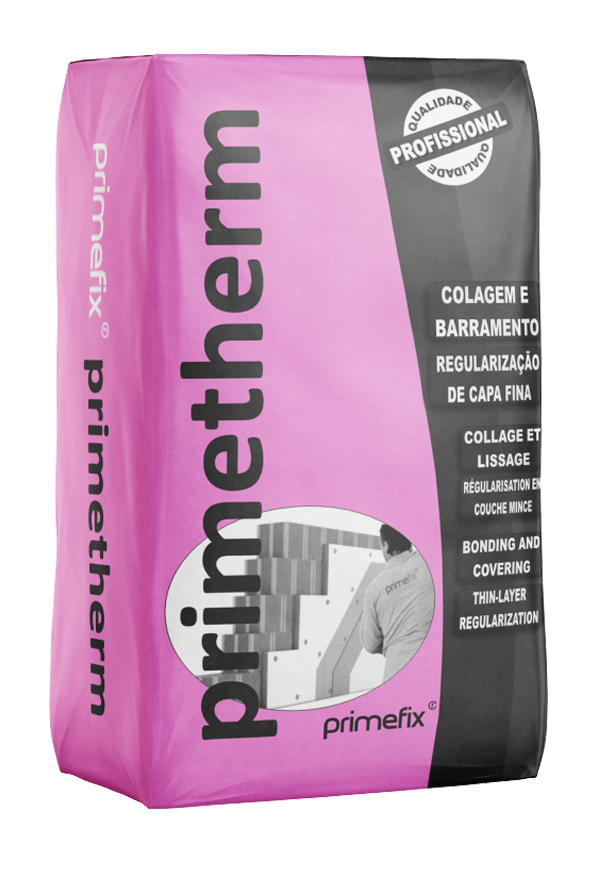
Fiber mortar for bonding and smoothing the ETICs system (EPS/ICB plates) and exterior concrete, brick and cement block masonry.
Packaging
Pallet of 56 bags of 25 kg (1400 kg)
Box of 20 kg (4 bags x 5 kg)
Color
White
Gray
Description
GP CS IV Wc2 Fiber Mortar, single-component, suitable for bonding and smoothing thermal insulation panels (EPS/ICB) to cement plaster substrates, ceramic brick masonry and thermal blocks. For applying reinforced thin plaster .
Typical use: SITE (ETIC'S) External Thermal Insulation System. Smoothing/Rehabilitation of surfaces, functioning as a plaster.



Properties
Simple and quick application, low cost, high durability. Controlled shrinkage and excellent adhesion properties. Sanded texture. Versatility in manual and mechanical application.
Composition
Composed of cement, mineral fillers, resins and specific additives.
Support
Thermal insulation panels (EPS and ICB), ceramic brick masonry, cement/thermal blocks, cementitious plasters. Painted substrates or substrates with organic coatings, as long as they are properly prepared (seen on a case-by-case basis).
Application instructions
- Knead the powder with 6.0L of clean water per 25 kg bag, manually or with a slow electric mixer until you obtain a consistent, homogeneous dough without lumps. Leave the dough to rest for 5 minutes, give it a little stir and it will be ready to use;
- The addition of other products may compromise the characteristics of the mortar. Do not use a product that has started to set hydraulically;
- Gluing : EPS insulation panels can be glued in two ways: by total gluing with the surface coating of the support and the face of the panel to be glued, using a notched trowel with the appropriate tooth size to ensure uniform adhesion across the entire piece, or by applying a perimeter bead of mortar all around the panel and an X-shaped bead in the centre of the panel; this operation requires the panel to be pressed against the support. ICB (cork) panels are only applied by total gluing with the surface coating and the face of the panel to be glued. This surface coating must ensure that any holes in the surface are filled;
- The plates must be placed in a staggered manner, that is, in an inverted position;
- Carry out a preliminary study of the positioning of the panels, taking into account the existence of windows, doors, window sills, projections, corners and balconies. The panels are glued from the bottom up, placing the starting profile and respective frame;
- When gluing the panels, avoid the presence of adhesive mortar in the joints between panels, in order to avoid thermal bridges. Fill the gaps in the joints between panels with the same insulating material;
- After the bonding product has dried, apply dowels suitable for the type of substrate and the type of insulation, applying at least 6 to 8 dowels/m2 . This mechanical fixing is a supplementary complement and does not replace gluing. The fixing point of the dowels must coincide with the gluing points;
- Barrier : The insulation boards must be barriered in 3 sequential phases: Apply localized barrier to the anchor fixing areas and apply fiberglass mesh reinforcements at specific points, as well as apply all reinforcement profiles; 2. Apply the first layer of barrier over the entire surface by incorporating the fiberglass mesh (e.g.: 150/160 g/m2 mesh and 5mm x 5mm mesh with anti-alkaline treatment). This mesh must be properly extended, ensuring that it overlaps at the joints; 3. After drying, apply the second layer of barrier appropriately, in order to give the final appearance. The minimum thickness per layer must be 2 mm; apply the mortar manually (with a metal trowel) or with a spraying machine (projecting from the bottom upwards onto the support, forming parallel cords), pressing the mortar;
- The waiting time between layers may vary depending on the environmental conditions present (under normal conditions, the waiting time is 1 day);
- In cases where the ETICS System is subject to stronger demands, it is recommended to apply 2 layers of fiberglass mesh + multi-bar. This is the case of reinforcing the system for “anti-vandalism” or gluing ceramics on ETICS. See Technical Data Sheet for Primeflex C2TES1 cementitious adhesive (analyze as appropriate);
- A minimum curing time of 7 days is recommended before applying the final decorative finish.
Technical Data
|
Application: |
Outdoor |
|---|---|
|
Application temperature: |
5º C a 30º C |
|
Recommended Maximum Application Thickness: |
6 mm |
|
Granulometries: |
≤ 0,5 mm |
|
Pot life of the paste: |
approximately 50 minutes, depending on the environmental conditions present at the application site |
|
Consumption: |
1,7Kg / (m2 x mm de espessura); |
|
Bonding of plates = |
3 to 5 kg/ m2 + total smoothing with 2 layers of 2 mm/layer = 7 kg/m2 ( medium) |
|
Cleaning: |
Water |
|
Color: |
Gray or white |
|
Packaging : |
25 kg paper bags / Pallet: Euro pallet 48 bags; Euro pallet 60 bags; National Pallet 56 bags |
|
Storage: |
1 year from the date of production, in closed original packaging and protected from heat and humidity. |
CE Marking Data
|
Reaction to fire: |
NPD |
|---|---|
|
Adhesion |
≥ 0,6 N/mm2 -FP:B |
|
Flexural strength: |
≥ 4 MPA |
|
Compressive Strength: |
CS IV |
|
Water absorption by capillarity: |
Wc2 |
|
Water vapor permeability: |
5/20 |
|
Thermal Conductivity (Tabled value) λ10,dry;P=50 : |
0,47 W/mºK |
|
Durability: |
Validated by declared performance classes |
Receive additional information